
On the morning of 23 January 2025, the air inside Paragon Hall was thick with the scent of jasmine garlands and the synthetic shimmer of rainbow confetti. Hundreds of same-sex couples sat in neat rows, waiting for a moment that had been unthinkable a decade earlier: a legal marriage registration. Thailand had just become the first nation in Southeast Asia, and the third in Asia, to enact full marriage equality. Outside, the BTS skytrain hummed past Siam station; inside, a quiet revolution was being notarised one signature at a time.
For the couples who queued that day, many of whom had been together for years, the law promised something tangible. Joint property, inheritance, medical decision-making, the right to adopt. By December, more than 24,500 couples had registered their unions nationwide, roughly 6,100 of them in the capital alone. The numbers are a genuine victory, yet they only begin to describe what equality feels like for the generation now coming of age.
Because the morning after the confetti settled, the questions that truly shape a young queer life in Bangkok were still waiting.
“It is a pity that LGBTI folks are superficially presented in media or exploited for commercial or political gains rather than being truly understood and respected,” says Suthat Rattanamaneethip, a 25-year-old content creator who spoke to the Bangkok Post after Pride in June 2025. “The first priority is to implement education reform.”
Suthat’s frustration is not abstract. In September 2025, the Luke Kaew Project, a collaboration between the Mplus Foundation and the Thai Health Promotion Foundation, released harrowing data from 509 LGBTQI+ students across 10 Bangkok schools. Twenty-six percent had considered suicide; 13.6 percent had attempted it. Nearly four in ten had endured verbal or psychological harassment because of their sexual identity, and 15 percent had been physically abused. Half reported facing regular stigma. When asked where the harassment happened, students most often named their own school.
That figure echoes an older study, conducted by Mahidol University with UNESCO and Plan International in 2014, which found that 55.7 percent of LGBT students had been bullied in the previous month. None of the 30 schools surveyed had a written anti-bullying policy. A decade later, activists say the national curriculum still does not mandate inclusive sex education, and a teacher’s language can slide between bemused tolerance and outright shaming.
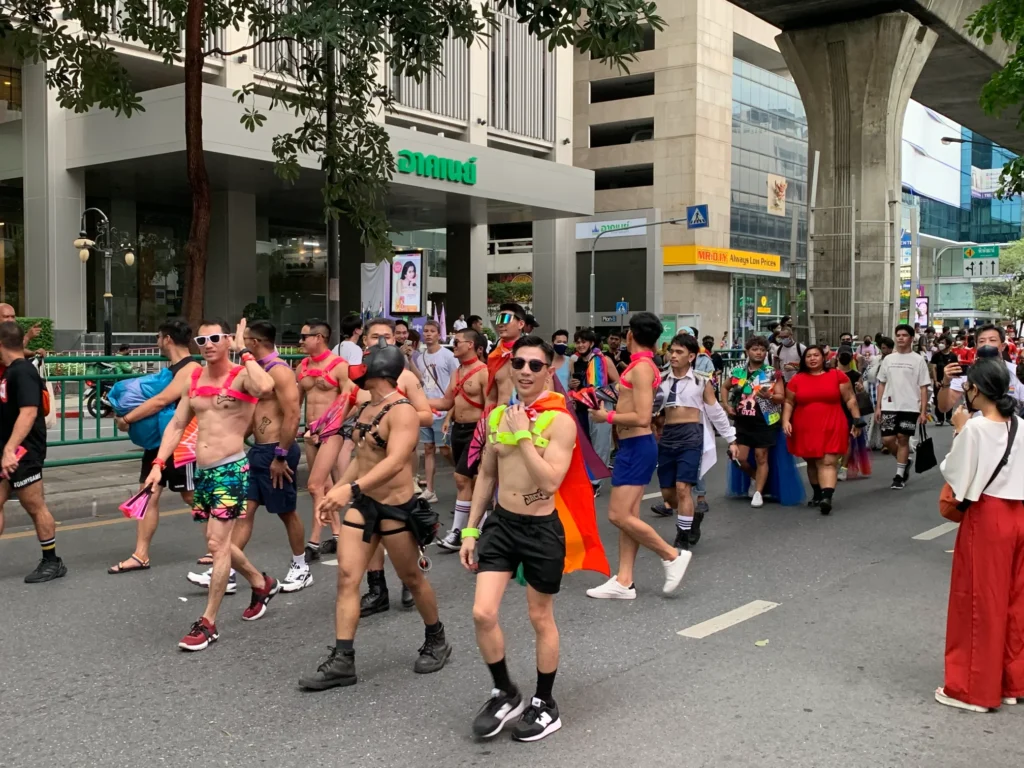
Yet the broader canvas is not entirely bleak. A 2024 YouGov survey found that 74 percent of Thais support same-sex marriage, a jump from 63 percent five years earlier. Among Gen Z, happiness and pride were the dominant emotions. Bangkok Pride 2025 drew more than 300,000 people, up from 250,000 the year before, and the prime minister herself marched behind a 200-metre rainbow flag. Legal victories, it seems, have shifted public sentiment, at least among the young and the urban.
But the law has not caught up to that sentiment. The Marriage Equality Act was an amendment to the Civil and Commercial Code; it swapped “husband” and “wife” for “spouse,” but it left other statutes untouched. The Nationality Act still only allows a foreign woman who marries a Thai man to obtain citizenship. The surrogacy law remains written for heterosexual couples. And there is still no national anti-discrimination law that explicitly protects sexual orientation and gender identity, though the Justice Ministry began drafting one in late 2025.
Most glaring of all is the absence of legal gender recognition. Transgender and intersex people cannot change their legal title; a trans woman marrying under the new law must still be registered as “husband.” A draft Gender Recognition Bill, proposed by Move Forward Party MP Tunyawaj Kamolwongwat, was rejected by parliament in February 2024 by 257 votes to 154. As of early 2026, four competing versions of the bill are under review, but no vote has been scheduled.
“Marriage equality is not the end,” says Chumaporn Waaddao, co-founder of Bangkok Pride and one of the architects of the marriage law. “It is a new beginning.” Speaking to Taiwan’s Central News Agency in December 2025, Chumaporn listed the next decade’s priorities: gender recognition, anti-discrimination legislation, a reformed education system. For her, the Pride parade is both celebration and protest. “It’s like other demonstrations,” she says. “Occupy the street and voice your demands.”
The voices of the next generation are already doing exactly that. Jirajade Wisetdonwail, a 27-year-old educator who co-founded Bangkok Pride, teaches queer ecology. She asks schoolchildren to sit quietly in a forest and listen. “Everything in the forest can express itself freely,” she says. “If we do this regularly, queer kids who were bullied will speak up.” Her approach is patient, ground-level work, the kind that legal reform cannot mandate.
Cher, a 19-year-old nonbinary sapphic law student from Bangkok, puts it more bluntly. In a blog for UNICEF’s Young Health Programme, Cher writes that “pregnancy and childbirth are still legally recognised only for men and women,” and that “hormone treatments remain costly for everyone.” Cher wants to be a lawyer, not simply to argue cases but to rewrite the rules.
What does it mean to grow up queer in Bangkok today? For many, it still means navigating a city where liberty lives in layered code. Silom Soi 4, the narrow lane that has served as the city’s queer heart since the first gay bar, the Sea Hag, opened in 1967, still pulses with neon and laughter. But the real frontier is online, where young people find community on TikTok, Discord, and fan forums, often before they find it in their own families. The digital realm has become the first closet door to ease open, and for some, the only one.
The generation that queued for marriage certificates in January 2025 grew up without role models in parliament or on television. The generation now in Bangkok’s high schools can point to a married lesbian couple on the evening news. That shift is not cosmetic; it is foundational. But it is not yet finished. As Chumaporn told the faithful assembled at Siam Paragon in May 2025: “The law is just one piece. The real change is in the minds of people.”
And in the sticky, jasmine-scented heat of a city that never stops building, the young are busy laying the next brick.
UN Human Rights Office, “Thailand: UN Human Rights Office welcomes enactment of historic marriage equality law,” 23 January 2025, https://www.bangkok.ohchr.org/news/2025/thailand-un-human-rights-office-welcomes-enactment-historic-marriage-equality-law
Thailand Government Public Relations Department, “Thailand’s Marriage Equality Law Takes Effect January 22,” 14 January 2025, https://thailand.prd.go.th/en/content/category/detail/id/52/iid/355315
Bangkok Post, “Cheers Queers! 2025’s LGBTI news in review,” 22 December 2025, https://www.bangkokpost.com/life/social-and-lifestyle/3161214/visual-stories (data on marriage registrations and gender recognition bill status)
The Star, “A Quarter of LGBTQI+ students in Bangkok have considered suicide,” 14 September 2025, https://www.thestar.com.my/aseanplus/aseanplus-news/2025/09/14/a-quarter-of-lgbtqi-students-in-bangkok-have-considered-suicide
42 Degrees, “Bullying targeting secondary school students who are or are perceived to be transgender or same-sex attracted,” 2014 (summary), https://www.42d.org/2020/08/14/bullying-targeting-secondary-school-students-who-are-or-are-perceived-to-be-transgender-or-same-sex-attracted-types-prevalence-impact-motivation-and-preventive-measures-in-5-provinces-of-thailand/
YouGov, “Thai residents show strong support for Marriage Equality Bill,” 31 July 2024, https://yougov.com/articles/50218-thai-residents-show-strong-support-for-marriage-equality-bill
Bangkok Post, “THE NEXT CHAPTER?” 30 June 2025 (via Magzter), https://www.magzter.com/de/stories/newspaper/Bangkok-Post/THE-NEXT-CHAPTER (quotes from Suthat Rattanamaneethip)
Bangkok Post, “Teaching gender diversity,” 10 March 2025, https://www.bangkokpost.com/life/social-and-lifestyle/2976533/teaching-gender-diversity (quotes from Jirajade Wisetdonwail)
UNICEF, “Cher’s Journey: Advocating for Equality and Change,” 21 March 2025, https://www.unicef.org/youthledaction/blog/chers-journey-advocating-equality-and-change
Central News Agency (Taiwan), “泰國同婚將滿一年 倡議領袖春瑪蓬:平權運動仍未結束,” 21 December 2025, https://www.cna.com.tw/news/aopl/202512210160.aspx (quotes from Chumaporn Waaddao)
Wikipedia, “Gender Recognition Bill (Thailand),” https://en.wikipedia.org/wiki/Gender_Recognition_Bill_(Thailand)
Bangkok Post, “Govt preparing broad anti-discrimination bill,” 2 December 2025, https://www.bangkokpost.com/thailand/general/3148350/govt-preparing-broad-antidiscrimination-bill
NBT World, “PM Joins Bangkok Pride with 300,000 Attendees,” 2 June 2025, https://thainews.prd.go.th/nbtworld/news/view/1166263/?bid=1
Islands, “Bangkok’s Best Nightlife For LGBTQ+ Travelers Is In A Neighborhood Full Of Immaculate Food And Shopping,” 21 April 2025, https://www.islands.com/1834885/bangkok-best-nightlife-lgbtq-travelers-neighborhood-immaculate-food-shopping-capital-silom/ (historical reference to Sea Hag and Silom Soi 4)